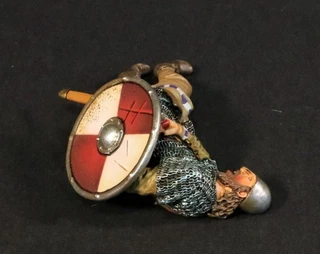
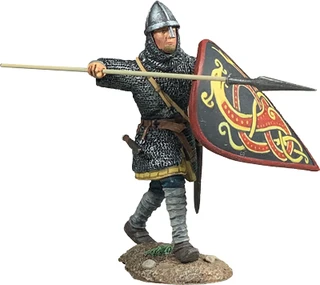
John Jenkins Toy Soldiers SX-66B Anglo Saxon/Danes Age of Arthur. 2 piece set. A Housecarl was a non-servile manservant or household bodyguard in medieval Northern Europe. The institution originated amongst the Norsemen of Scandinavia, and was brought to Anglo Saxon England by the Danish conquest in the 11th Century. They were well-trained, and paid as full time soldiers. In England, the royal housecarls had a number of roles, both military and administrative. According to 12th Century Danish historian, Svend Aggeses, Cnut's housecarls were governed by a specific law, the "Witherlogh" or "Lex Castrensis". Their organization in a band or guild was Scandinavian in character, but the legal process the "Witherlogh" defines is mainly derived from canon law, directly or through Anglo Saxon laws. The "Witherlogh" defined an etiquette, such as Housecarls were to be seated at the kings' tables according to a number of factors, among which skill in war and nobility. They could be disgraced by being moved to a lower place at the tables. This was mainly punishment for minor offences, such as not giving proper care to the horse of a fellow housecarl. After three such offences, the offender could be seated at the lowest place where no-one was to talk to him, but everyone could throw bones at him at will.
The murder of another housecarl was punished by exile, and treason was punished by death, and confiscation of all property. Quarrels between housecarls were decided by a specific tribunal, in the presence of the king.
By the end of the 11th Century in England, there may have been as many as 3,000 royal housecarls. The housecarls of Harold Godwinson's army had a crucial role as the backbone of Harold's army at Hastings. Although numerically they were the smaller par of Harold's army, their superior equipment and training meant they could have been used to strengthen the militia, or "Fyrd", which made up most of the Anglo Saxon army. The housecarls were positioned in the centre around the leader's standard, but also probably in the first ranks of both flanks, with the fyrdmen behind them. At the Battle of Hastings, these housecarls fought after Harold's death, holding their oath to him until the last man was killed.
Authentic hand painted soldiers and miniatures for collectors designed and produced in Hong Kong by John Jenkins Designs. John Jenkins Designs is focused on bringing specific battles and events from history to life. Periods of history ranging from the French and Indian War to the World War II are all covered by the toy soldiers of John Jenkins Designs.
John Jenkins is perhaps best known for its stunning recreations of World War I aircraft and the daring pilots who were known as Aces. In addition to the Knights of the Sky, John Jenkins Designs creates toy soldiers and tanks from The Great War at a level of detail not seen anywhere else in the industry. British, French, and German vehicles all have the weathering and a level of dirt or mud that seemed to accumulate after only just a few days at the front. Joining the German, French, and British toy soldiers are the Americans; late to the war but providing the vital push that finally broke through the static lines of grindingly slow trench warfare.
Back in history, the French and Indian War has provided John Jenkins Designs with fertile ground for toy soldier production. The Raid on Saint Francis, the 1759 Battle of Ticonderoga, and many others are all brought to life by the dynamic action poses and unique regiments that fought at each. The colonies were responsible for raising regiments to fight their battles against the encroaching French and their Native allies, and John Jenkins Designs produces New Jersey, Pennsylvanian, South Carolina, Connecticut, and the 60th Royal American Provincials as toy soldiers to represent the variety of those regiments.
Unique ranges produced by John Jenkins Designs are The Jacobite Rebellion, The Seven Years War, The War of 1812, The Wars of the Roses, and The Town of Old Yangshuo among others. Perhaps one of the most unique of them all is the Speedbirds Collection, representing a period of time between WWI and WWII when aircraft design advanced by leaps and bounds as inventors attempted to capture the prestigious Schneider Trophy, awarded from 1913-1931. These fully painted and assembled airplane models are of a smaller scale than the normal 1:30th scale toy soldiers and accessories produced by JJD, so no pilots or other items are planned to accompany them at this time.
New in the original box 1/30 scale 60mmAuthentic hand painted soldiers and miniatures for collectors designed and produced in Hong Kong by John Jenkins DesignsPlease buy with confidence as we are an...
King & Country Toy Soldiers RH013 Arthur a Bland. Arthur was caught red-handed by the Sheriff's men poaching one of the King's deer (a hanging offence in those days). Fortunately he managed to escape...
This Saxon name is derived of two elements: "Audaz" shortened to "Ēad" (prosperity, fortune, or wealth) and "Gaizaz" simplified to "Gar" (spear or pike). Combined the name means "prosperous spearman...
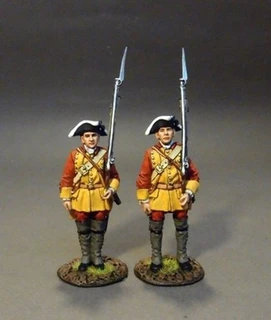
John Jenkins Designs Collectible Toy Soldiers The Eighteenth Century Collection The Raid On St Francis 1759 RRBC-03 The Connecticut Provincial Regiment, 2 Line Infantry At Attention New in the...
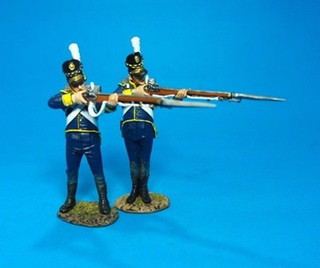
John Jenkins Designs Collectible Toy Soldiers The Nineteenth Century Collection The Peninsular War 1807 - 1814 PORT-09B Portuguese Line Infantry, 21st Line Infantry Regiment, 2 Figures Firing, Blue...